In the age of AI, our interaction with information is changing dramatically. We’re moving past simple keyword searches to a world where computers understand the meaning behind our words, images, and even sounds. This leap isn’t magic; it’s powered by a fascinating technology called Vector Databases.
If you’ve ever asked ChatGPT a nuanced question, used Google Photos to search for “dogs playing in a park,” or received hyper-relevant recommendations on Netflix, you’ve experienced the magic of vectors at play. So, let’s pull back the curtain and explore why these databases are becoming the unsung heroes of AI.
The Problem: Computers Don’t “Understand” Like Humans Do
Imagine trying to teach a computer what “love” means. You can give it definitions, examples, and synonyms, but a computer fundamentally sees words as just strings of characters. It doesn’t inherently grasp the subtle connections, emotions, or contexts that humans do.
Traditional databases are fantastic for finding exact matches: “Show me all customers named ‘Sarah’ in New York.” But ask a traditional database, “Show me all documents related to sustainable energy solutions,” and it struggles. It can only look for the exact keywords “sustainable,” “energy,” and “solutions”—missing countless other relevant documents that use different phrasing.
The Solution: Giving Data a “Meaningful Address”
This is where vector databases step in. They solve the “understanding” problem by converting all sorts of data (text, images, audio, video) into a special numerical format called vectors (also known as “embeddings”).
Think of a vector as a unique numerical fingerprint or an address in a vast, multi-dimensional space of meaning.
• Words and phrases that are semantically similar (e.g., “fast car” and “speedy automobile”) will have vectors that are numerically close to each other in this space.
• Images of similar objects (e.g., two different pictures of a cat) will also have vectors that are near each other.
• Completely unrelated concepts (e.g., “pizza” and “quantum physics”) will have vectors that are far apart.
The process of turning raw data into these meaningful vectors is called embedding, and it’s usually done by powerful AI models.
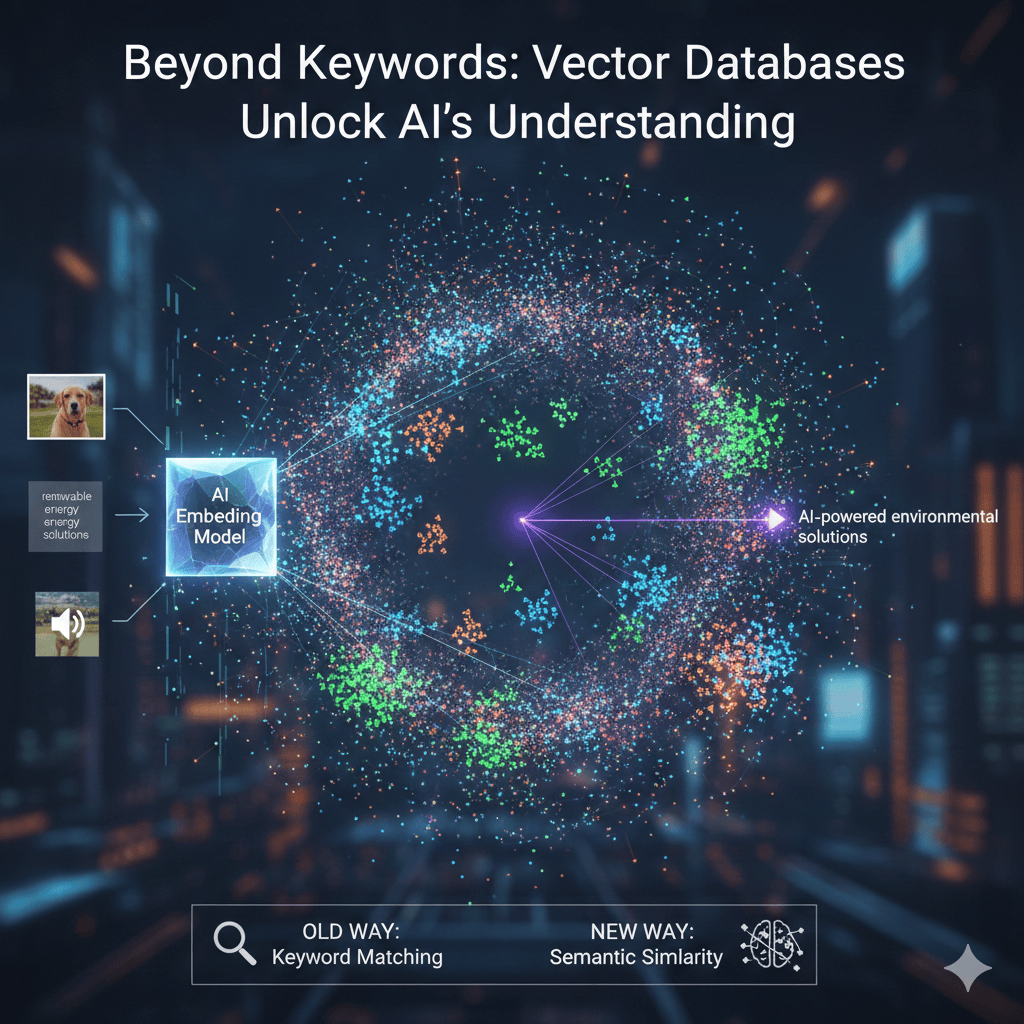
How Vector Databases Work: A Step-by-Step Journey
Let’s break down the magic:
1. The Embedding Process: Turning Data into Vectors
• You take your data—whether it’s a paragraph of text, a product image, or an audio clip of a bird singing.
• You feed this data into a specialized AI embedding model. This model has been trained on vast amounts of data to understand the nuances of language or visual patterns.
• The model outputs a long list of numbers (e.g., [0.123, -0.456, 0.789, …]). This is your vector (or embedding). The length of this list can range from hundreds to thousands of numbers, each representing a “dimension” of meaning.
2. Storing the Vectors
• The vector database then stores these numerical vectors, usually alongside the original data or a reference to it.
• Crucially, it organizes these vectors in a way that makes finding similar ones incredibly fast. This isn’t like sorting words alphabetically; it’s more like spatially arranging them.
3. The Query: Finding “Similar” Meaning
• Now, you have a new piece of data—say, a user’s search query: “sustainable energy solutions.”
• This query is also converted into its own vector using the exact same embedding model that created the vectors in your database.
• The vector database then performs a similarity search. It looks for all the stored vectors that are numerically “closest” to your query vector. The closer the vectors, the more semantically similar the underlying data is.
4. The Result: Contextually Relevant Information
• The database returns the original data (or references to it) associated with the closest vectors.
• Instead of just matching keywords, you now get results that are contextually relevant—documents about solar panels, wind farms, or geothermal energy, even if they never used the exact phrase “sustainable energy solutions.”
Why Are They So Hot Right Now? The Rise of Generative AI
Vector databases aren’t new, but their importance has skyrocketed with the advent of Generative AI models like ChatGPT.
1. Long-Term Memory for LLMs (RAG): Large Language Models (LLMs) have a knowledge cutoff and don’t inherently know about your company’s private data or the latest real-world events. Vector databases provide a “long-term memory” for LLMs. This technique, called Retrieval-Augmented Generation (RAG), allows LLMs to retrieve fresh, relevant information from a vector database before generating a response, making them more accurate, timely, and specific.
2. Semantic Search: Go beyond keyword matching in your applications. Find products by description, not just name. Search documents by meaning, not just exact phrases.
3. Personalized Recommendations: If a user likes a movie whose vector is A, find other movies whose vectors are numerically close to A.
4. Anomaly Detection: If a new network activity vector is far from all known “normal” vectors, it might indicate a security threat.
5. Multimodal Search: Search for images using text descriptions, or find audio clips that match a video.
Looking Ahead
Vector databases are rapidly evolving, integrating with traditional databases and becoming a core component of how we build intelligent applications. They are fundamental to unlocking the true potential of AI, allowing machines to not just process information, but to genuinely understand and reason with it.